View Project
SYSTEM APPRAISAL AND CAPACITY DEVELOPMENT OF AQUAFARMERS AND RURAL YOUTHS FOR RESILIENT BRACKISHWATER AQUACULTURE IN INDIA
Status: New
Lab/Organization
| Name & address of the Laboratory/Organization | ICAR-Central Institute Brackishwater Aquaculture, Chennai | |
| Website address | https://ciba.icar.gov.in | |
| Affiliated to which Department/Ministry | Indian Council of Agricultural Research (ICAR) | |
| CSR Registration Number | GSR 776(E) | |
| Registration under 12A | ||
| Registration under 80G | ||
| Name of the CSR Nodal | Dr. R. Geetha | |
| Contact information of CSR Nodal | 7299201687 , 8072455669, geetha.r@icar.gov.in | |
| Principal Investigator | Dr. R. Ananda Raja, ananda.Raja@icar.gov.in https://ciba.icar.gov.in/?post_type=edmento_faculty&p=1793 |
|
| Co- Principal Investigator (Co-PI) | Dr. M. Kumaran, m.kumaran@icar.gov.in | |
Project Detail
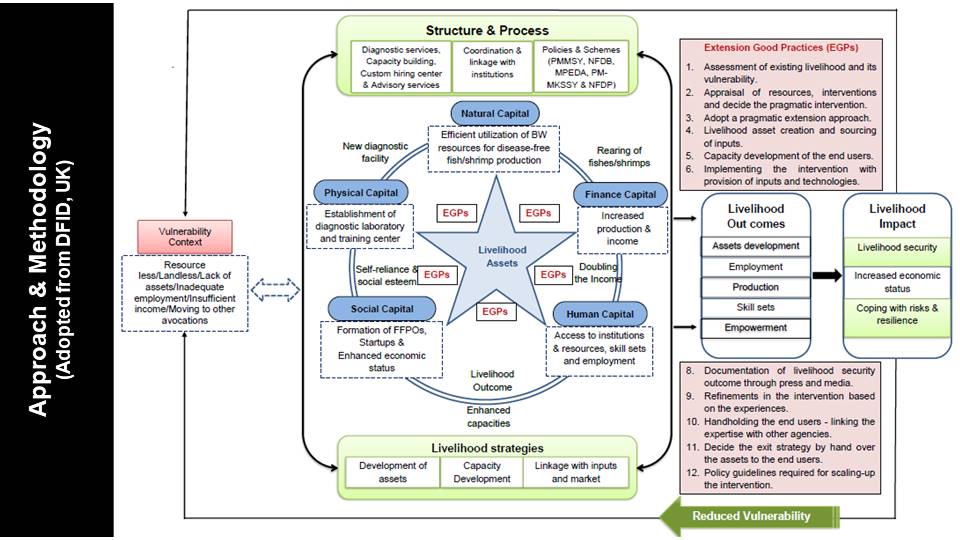
| Objective on the basis of need | i. To undertake appraisal of brackishwater aquaculture systems for technologies and diagnostic service requirements in different aqua climatic zones. ii. To develop a system specific capacity building modules and generate a team of technical expertise in rural India for each system of brackishwater aquaculture. iii. To establish functional linkage with various institutions and stakeholders for obtaining opportunities available under different programmes or schemes for the sustainable development of youths in brackishwater aquaculture. iv. To assess the production efficiency of the brackishwater aquaculture systems and employment generation of rural youths. |
| Executive summary of the proposed project (In 250 words) | Total Indian seafood export is 17.35 lakh MT during 2022-23 worth of INR 63,969 crores with major contribution from frozen shrimp worth of INR 43,135 crores (1.184 million MT). India aims to raise the shrimp production to 1.6 by 2030, followed by 3 million tonnes in 2047 through the introduction of indigenous species and super-intensive precision farming. Simultaneously, there is an anticipation of increasing the production of Asian seabass, Milkfish, Pearlspot, and Mud crab from 8000, 10000, 3000, and 3481 tons to 20000, 25000, 6000, and 500000 tons during 2028-29, respectively. To achieve this, there are different types of farming systems followed and the problems are also unique to each system, which needs specific technical expertise for each system. Diseases are considered to be the most confounding factor but can be rectified if diagnosed at an early stage with technical expertise. Total annual employment loss due to shrimp diseases in India is 1.65 million man-days worth of INR 52.3 crores. The overall probability of infectious disease occurrence is 49% leading to an annual loss of INR 7543.67 crores. Having good literacy but lack of land resources, the rural youths have been either migrating and/or serving as the unskilled labourers in different fields. Hence, it is another approach to select the educated and unemployed youths, and teach and train them with basic aquaculture diagnostic skills. This will be a kick-start opportunity for educated and unemployed youths, to become an expert over the years of involvement and experience. |
| Technology Readiness Level (If not a new project but an advancement of existing know how) | ICAR-CIBA has been offering various training programmes in brackishwater aquaculture on payment basis (Ananda Raja and Sujeet Kumar, 2012; Ananda Raja, 2022). In addition, ICAR-CIBA has been giving its technical expertise to train the youths of Andhra Pradesh for brackishwater aquaculture in collaboration with Andhra University and Avanti Foundation. Moreover, ICAR-CIBA in collaborations with Coastal Aquaculture Authority (CAA), Marine Products Export Development Authority (MPEDA), and Rajiv Gandhi Centre for Aquaculture (RGCA) has conducted a polymerase chain reaction (PCR) ring test with 25 laboratories for assessing and enhancing the skills of personnel in associated laboratories and found 17 labs successfully qualified (ICAR-CIBA, 2017). As an need of the hour, ICAR-CIBA in collaboration with ICAR-CIFE, has also conducted a “Certificate Course on Risk Management Survey and Loss Assessment in Shrimp Farming”' for successful implementation of shrimp crop insurance (ICAR-CIBA, 2024). Much more is needed to cover the entire country to meet out the enormous technical requirements in the industry and also to empower the rural poor youths. |
| Outomes or Deliverables | 1. Refined technologies for different brackishwater aquaculture systems. 2. SOPs for each system of brackishwater aquaculture with specific reference to disease mitigation. 3. At least 540 numbers of technical expertise for brackishwater aquaculture. 4. Employment generation and economic upliftment of rural youths. 5. Technical expertise for successful implementation of aquaculture crop insurance, NFDP, etc. |
| Project aligned with which most relevant UN SDGs | Goal 1 - No Poverty Goal 2 - Zero Hunger Goal 3 - Good Health & Well-Being Goal 8 - Decent Work & Economic Growth Goal 14 - Life Below Water |
| Duration (In years) | Three Years |
| Expected Impact | i. Disease mitigation SOPs for different brackishwater aquaculture systems such as traditional aquaculture, intensive aquaculture, precision farming, RAS, raceways, biofloc, tank based aquaculture, polyculture, new hatchery operations, etc. ii. System specific capacity building modules as ready reckoner for water quality parameters, microbiological, molecular, gross and histopathological parameters. iii. A team of technical expertise (540 numbers) in east and west coast of rural India for different systems and schemes of brackishwater aquaculture. iv. Employability of rural youths with technical skills. v. Two Ph.D. degrees in the related field. vi. A color atlas for gross and histopathology of normal and diseased fish and shrimp. |
| Implementation model (self- implemented/ outsourced partnership) | Self- implemented model |
| Total Budget (Recurring +Non-Recurring Expenses) | Rs. 9876000/- (5316000+4560000) |