View Project
Structural Colored Paints from Repurposed Polymeric Waste as Sustainable Alternatives to Chemical Pigments
Status: New
Lab/Organization
| Name & address of the Laboratory/Organization | Indian Institute of Technology (IIT), Hyderabad | |
| Website address | www.iith.ac.in | |
| Affiliated to which Department/Ministry | Indian Institute of Technology (IIT) | |
| CSR Registration Number | CSR00012157 | |
| Registration under 12A | ||
| Registration under 80G | ||
| Name of the CSR Nodal | Dr. Mudrika Khandelwal | |
| Contact information of CSR Nodal | +919966355510, dean.acr@iith.ac.in | |
| Principal Investigator | Dr. Mahesh Ganesan, maheshg@che.iith.ac.in https://sites.google.com/che.iith.ac.in/softmatter/home |
|
| Co- Principal Investigator (Co-PI) | ||
Project Detail
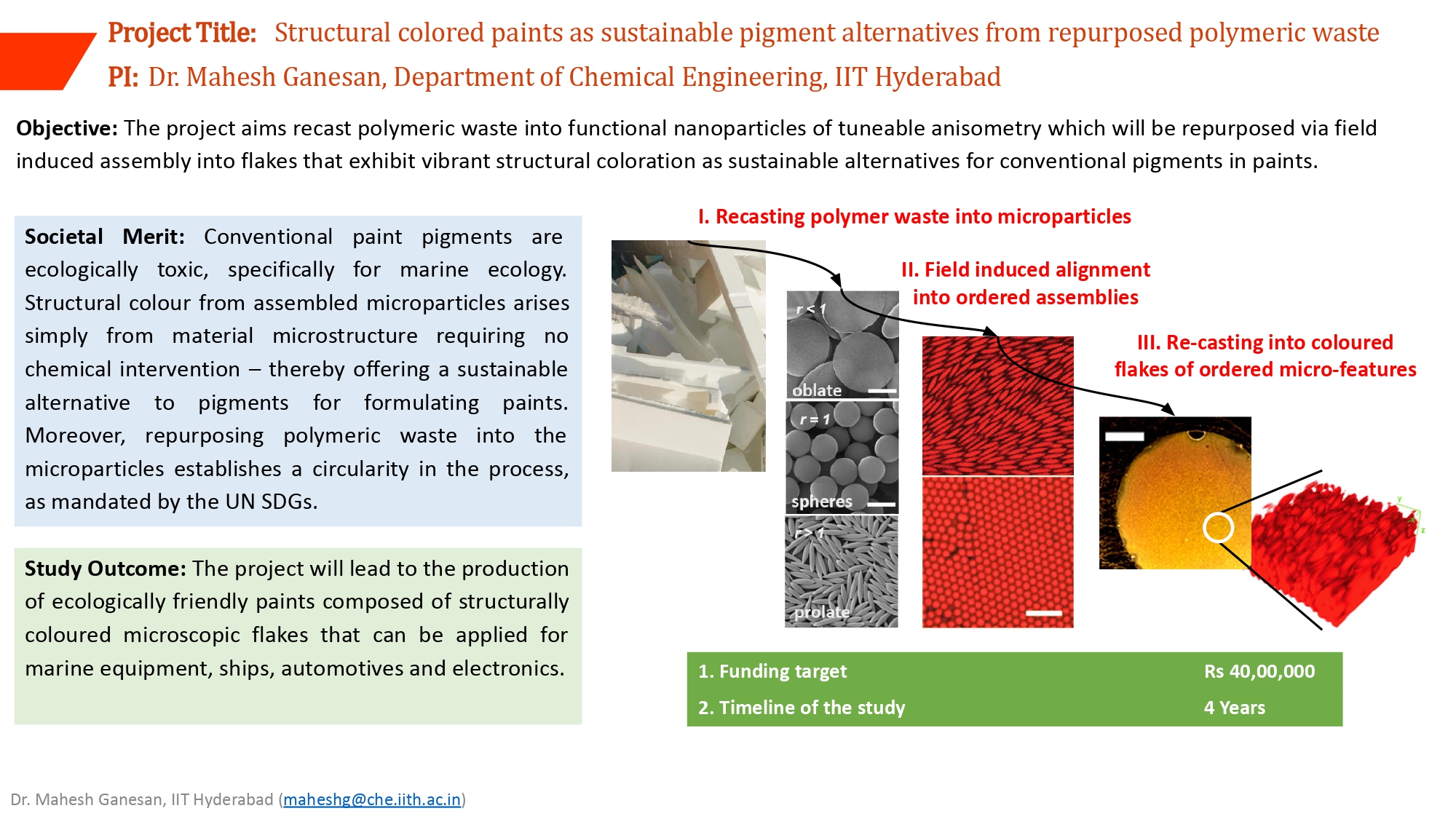
| Objective on the basis of need | The project aims to recast polymeric waste into functional nanoparticles of tuneable anisometry which will be repurposed via field induced assembly into flakes that exhibit vibrant structural coloration as sustainable alternatives for conventional pigments in paints. |
| Executive summary of the proposed project (In 250 words) | Conventional paint pigments are ecologically toxic, specifically for marine ecology. Structural colour from assembled microparticles arises simply from material microstructure and its interaction with incident ambient light and requires no chemical intervention. Thereby, structural color flakes offer a sustainable alternative to pigments for formulating paints. In this study, we will harvest the microparticles from polymeric waste where, the polymers will be recast into microparticles of tunable size and shape via methods of precipitation. The microparticle raw-material will be assembled into flakes that exhibit brilliant color due to their ordered microstructure. The assembly itself will be conducted through conventional mechanical and electrical force fields which do not require any extensive technology. Once assembled, the microparticle assembly will be milled to produce these flakes. The flakes can then be used to replace the chemical pigment for use in dyes, paints and coatings. When such paints wear away, they can again be repricipated into particles and routed back into the production chain using the method mentioned above. Moreover, repurposing polymeric waste into the microparticles establishes a circularity in the process, as mandated by the UN SDGs. |
| Technology Readiness Level (If not a new project but an advancement of existing know how) | New Project |
| Outomes or Deliverables | The project will lead to the production of ecologically friendly paints composed of structurally coloured microscopic flakes that can be used across different industries ranging from automotive, electronics, aerospace, marine and building and construction. |
| Project aligned with which most relevant UN SDGs | Goal 11 - Sustainable Cities & Communities Goal 12 - Responsible Consumption & Production |
| Duration (In years) | 4 years |
| Expected Impact | The project will lead to the production of ecologically friendly paints composed of structurally coloured microscopic flakes that can be used across different industries ranging from automotive, electronics, aerospace, marine and building and construction. |
| Implementation model (self- implemented/ outsourced partnership) | Self-implemented |
| Total Budget (Recurring +Non-Recurring Expenses) | 40 Lakhs |