View Project
Design, Development, Installation & Commissioning of Integrated Municipal or Rural Solid Waste Disposal System
Status: New
Lab/Organization
| Name & address of the Laboratory/Organization | CSIR-Central Mechanical Engineering Research Institute (CMERI) | |
| Website address | www.cmeri.res.in | |
| Affiliated to which Department/Ministry | Council of Scientific and Industrial Research (CSIR) | |
| CSR Registration Number | CSR00017422 | |
| Registration under 12A | ||
| Registration under 80G | ||
| Name of the CSR Nodal | Dr. Biplab Choudhury | |
| Contact information of CSR Nodal | 8972044652 , biplab@cmeri.res.in | |
| Principal Investigator | Dr. Amit Ganguly , a_ganguly@cmeri.res.in | |
| Co- Principal Investigator (Co-PI) | Partha Das , partha_das@cmeri.res.in | |
Project Detail
| Objective on the basis of need | Municipal Solid Waste (MSW) has become a challenge for Urban Local Bodies (ULBs) throughout the world. Providing good solid waste management (SWM) services and ensuring financial sustainability of the system continues to be a major challenge in cities of developing countries. Depending upon the country spending capacity; every nation generates a different quantity per capita of MSW. As per one estimate by CPCB (Central Pollution Control Board, New Delhi), in 2010, India generates 60 Million MT of MSW per annum. The growth rate of MSW generation for developing countries is over 5% on an annual basis. The major challenge of waste handling is lack of understanding over a diversity of factors that affect the different stages of waste management and linkages necessary to enable the entire handling system functioning. Poor collection and inadequate transportation are responsible for accumulation of MSW at every nook and corner. The management of MSW is going through a critical phase, due to the unavailability of suitable facilities to treat and dispose of the larger amount of MSW generated daily in metropolitan cities. Un-scientific disposal causes an adverse impact on all components of the environment and human health. This will cater to the “Swachh Bharat” & Swasth Bharat” mission of the government and help in making Clean India a reality. |
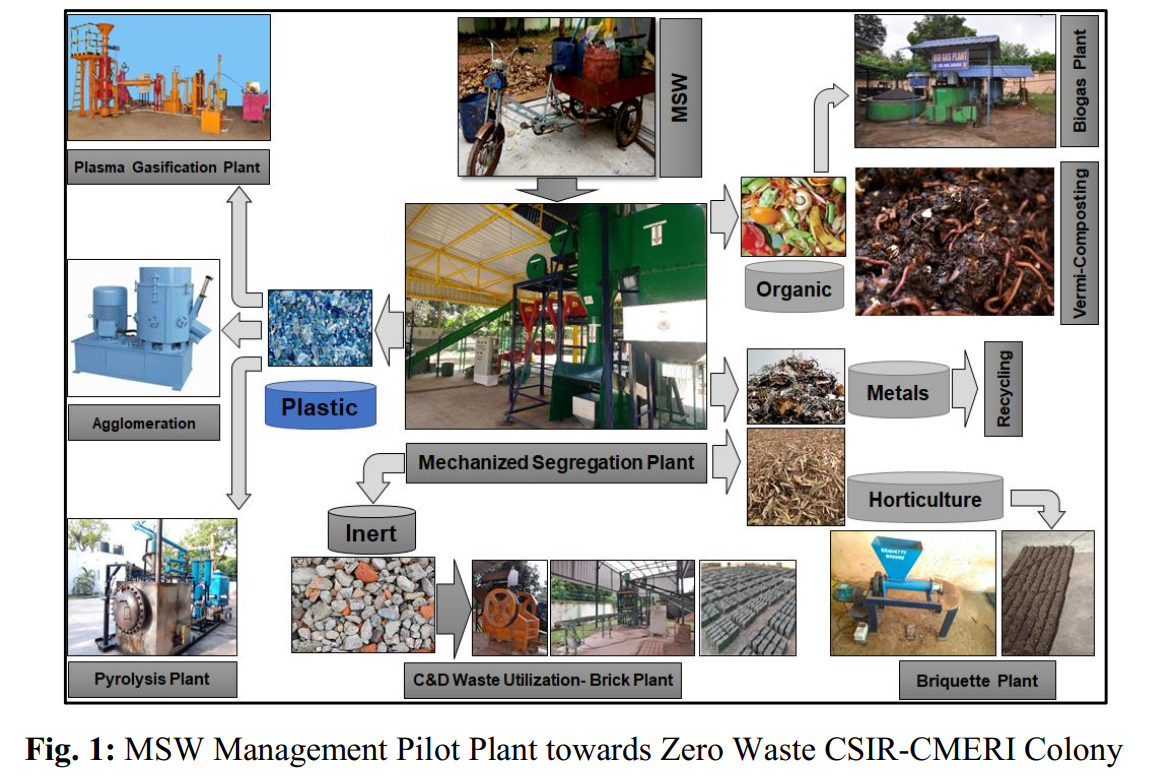
| Executive summary of the proposed project (In 250 words) | CSIR-CMERI has developed an integrated Municipal Solid Waste disposal system (i- MSWDS) for disposal of solid waste in a scientific way in-line with Solid Waste Management Rules (SWM) 2016 prescribed by Union Ministry of Environment, Forests and Climate Change (MoEF& CC), Govt. of India. The integrated municipal solid waste disposal system starts with the mechanized segregation of solid waste. The mechanized segregation system segregates solid waste into four components: metallic waste (metal body, metal container etc.), biodegradable waste (foods, vegetables, fruits, grass etc.), non-biodegradable (plastics, packaging material, pouches, bottles etc.) & inert (glass, stones etc.) wastes. The bio- degradable component of the waste is decomposed in an anaerobic environment popularly known as bio gasification. The biogas has a typical volumetric composition of 55–60% methane and 35–40% CO2 and it is being used as fuel for cooking purpose. The gas can also be utilized in gas engine for electricity generation. The residual slurry is a good organic manure and can be utilized as fertilizer. The organic waste is also converted to compost in a natural process known as vermi-composting by introducing earthworms. The vermi-compost is utilized in organic farming. Bio-waste such as dry leaves, dead branches, dry grass etc. are disposed of by first shredding it to a suitable size followed by mixing with the liquid slurry coming out of the biogas digester. This mixture is feedstock for briquette. These briquettes are being utilized as fuel for cooking. The segregated plastic waste can be converted into Refused Derive Fuel (RDF) in hydraulic press. These RDF may be utilized as an alternative fuel in furnaces. The segregated waste plastics alternatively are re-processed for the production of agglomerates. The agglomerates are then fed into the hot extrusion press where the plastic wires are produced. The plastic wires are then cut into smaller sizes as per the requirement for storage and further processing. These plastic granules have significant industrial use. The plastic granules are fed into horizontal or vertical injection moulding press. In the injection moulding process the plastic granules are first melted and then poured into die cavity. Different sized products can be manufactured. In addition to the above, the waste plastics are also disposed of through two other processes i.e. pyrolysis and plasma gasification. In the pyrolysis process, the polymer waste is heated to a temperature of 500–600°C in an anaerobic environment in presence of a suitable catalyst. The volatile matter from the polymer waste comes out as a result of heating which on condensation gives pyrolysis oiltermed as Petro Alternate Fuel (PAF). The crude pyrolysis oil after purification can be used in industrial boilers, generators etc. for heating / power generation purposes. The polymer waste or sanitary items are also disposed of utilizing high temperature plasma. The plasma gasification process converts the waste into syngas which can be utilized for generation of electricity. The construction and demolition (C&D) waste is re-processed for production of fines and aggregates. The oversized crushed materials with size > 4.0 mm and < 20.0 mm are used as aggregate in PCC road making.The fines with size < 4.0 mm are mixed with cement and water in appropriate proportion and bricks are produced in hydraulic brick press. The ready bricks are being used as construction materials. The integrated Municipal Solid Waste Disposal System (i-MSWDS) is installed at CSIR- CMERI Residential Campus where day-to-day waste generated at CMERI Colony are processed aiming towards a “Zero Waste CSIR-CMERI Colony”. The process layout is shown below: |
| Technology Readiness Level (If not a new project but an advancement of existing know how) | TRL-6 |
| Outomes or Deliverables | The Decentralised Solid Waste Management Technology (DSWMT) comprises of the following eight modules, which tries and provides solution for management of every aspect of Solid Wastes. The Technology Modules are: 1. Module-1: Mechanized Segregation of Solid Waste 2. Module-2: Biogas from organic fraction of solid waste 3. Module-3: Composting/vermin composting of bio-degradable waste 4. Module-4: Briquette making from agro/horticulture/bio-degradable waste 5. Module-5: Pyrolysis of plastic waste 6. Module-6: Agglomeration of plastic waste and re-processing 7. Module-7: Plasma gasification of plastic/sanitary waste 8. Module-8: Utilization of Construction & Demolition Waste |
| Project aligned with which most relevant UN SDGs | Goal 11 - Sustainable Cities & Communities Goal 12 - Responsible Consumption & Production |
| Duration (In years) | Six (6) months to Twelve (12) months based on the capacity of the plant. |
| Expected Impact | Socio-Economic Impact Solid Waste Management is labour intensive and can provide sustainable employment to people at the bottom of the economic ladder. This can improve the income distribution for some of the poorest members of the community. The employment effects of SWM projects can be such as the direct employment in construction, operation and maintenance; indirect employment of job creation in the supply chain supporting the projects; induced employment created because of the wages earned through direct and indirect employment spent in goods and services thus creating jobs. Improvement in Quality of Life Waste dumps have adverse impacts on the environment and public health. The U.S. Public Health Service identified 22 human diseases that are linked to improper MSWM. Some health problems linked to improper solid waste management are nose and throat infections, breathing difficulties, inflammation, bacterial infections, anaemia, reduced immunity, allergies, asthma and other infections. Waste worker and pickers handling waste are directly exposed to contaminants and hazardous materials, from fecal matter and medical waste to toxic fumes and chemicals that are co-disposed with MSW. This poses serious health threat to the workers associated with this job. Scientific disposal of solid waste will reduce a number of safety and health risks for the waste workers improving their quality of life significantly. Other high-risk group including population living close to a waste dump especially the pre-school children and those, whose water supply has become contaminated either due to waste dumping or leakage from landfill sites will be benefitted greatly. Environmental Impact Improper MSW disposal and management causes all types of pollution: air, soil and water. Indiscriminate dumping of wastes contaminates surface and ground water supplies. In urban areas, MSW clogs drains, creating stagnant water for insect breeding and floods during rainy seasons. Uncontrolled burning of MSW and improper incineration contributes significantly to urban air pollution. Open dumps release methane from decomposition of biodegradable waste under anaerobic conditions. Methane causes fires and explosions and is a major contributor to global warming. There are also problems associated with odour and migration of leachates to receiving waters. Odour is a serious problem, particularly during the summer when average temperatures in India can exceed 45°C. Using water polluted by MSW for bathing, food irrigation and drinking water expose individuals to disease organisms and other contaminants. Proper solid waste management will ensure that it does not affect the environment and not cause health hazards to the people living there. |
| Implementation model (self- implemented/ outsourced partnership) | outsourced partnership |
| Total Budget (Recurring +Non-Recurring Expenses) | The budget depends on the capacity of the plant and the modules required to be implemented |